study 1
Transmission-ratio tolerance
Mass minimization with tolerance values 0.05 and 0.2.
Paper comparison; no live solver or convergence trace is shipped.
Engineering optimization · executed benchmarks
Inspect a seeded particle swarm step by step, connect a design vector to an analytical mechanical response, and explore a separate permutation-valid travelling-salesman execution.
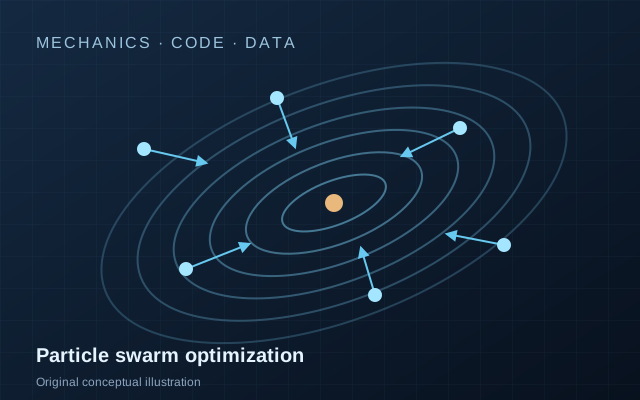
Deterministic algorithm replay
A real, seeded PSO sizes a rectangular steel cantilever. Scrub every stored state to inspect positions, velocities, personal bests and the global best. This benchmark is independent of the repository’s unavailable KDS objective.
24 × (1 + 40) = 984
Inertia weight
0.850
Global-best mass
2.166 kg
Global-best section
11.42 × 48.30 mm
Global-best constraints
Feasible
| Iteration | b [mm] | h [mm] | Mass [kg] | Stress [MPa] | δ [mm] | Status |
|---|---|---|---|---|---|---|
| 0 | 11.423 | 48.304 | 2.1657 | 90.05 | 1.480 | Feasible |
Permutation-valid execution
A seeded random-key PSO searches closed tours. Sorting each particle’s keys creates an explicit permutation, so every evaluated route visits each city exactly once before returning to the start.
32 × (1 + 80) = 2592
Best closed tour
361.236 km
Cities / visits
10 / 10
Evaluations used
32
Cycle closure
D → A
A → B → F → E → J → I → H → G → C → D → A
| Visit | City | x [km] | y [km] | Next |
|---|---|---|---|---|
| 1 | A | 8.000 | 18.000 | B |
| 2 | B | 24.000 | 10.000 | F |
| 3 | F | 68.000 | 48.000 | E |
| 4 | E | 75.000 | 22.000 | J |
| 5 | J | 4.000 | 40.000 | I |
| 6 | I | 13.000 | 66.000 | H |
| 7 | H | 31.000 | 55.000 | G |
| 8 | G | 51.000 | 62.000 | C |
| 9 | C | 42.000 | 17.000 | D |
| 10 | D | 58.000 | 8.000 | A |
Method boundary: random-key PSO is an explicit permutation encoding: key order determines the tour, while continuous velocity updates act on keys. It is an executed heuristic benchmark, not the repository’s MO-ETPSO/GVRP case and not a proof of the global optimum. Distances are Euclidean in the user-entered kilometre coordinate plane.
MO-ETPSO / GVRP · pinned public-source audit
This is a file-level evidence inventory, not an algorithm replay. It keeps the executed TSP above separate from the paper’s multi-objective Green Vehicle Routing Problem and prevents undocumented files from being presented as reproducible science.
Repository state
PUBLIC · 6 files inventoried
ff4e5a7a9f7c
No LICENSE, LICENSE.md, LICENSE.txt, COPYING or COPYING.md file exists at the verified commit. Public visibility does not grant reuse rights.
No executable source, dependency manifest or documented file schema exists at the verified commit. ProjectHub does not copy or execute these artifacts.
| File | Lines | Observed structure | Evidence boundary |
|---|---|---|---|
| README.mdRepository descriptionblob 962afeb5e9c9eb8b86882ea3dbfeaab559db5bc8 | 2 | Title plus the statement “Datasets for the Problems #1 and #2”. | It does not map filenames to paper cases, define units or declare a licence. |
| PG1.txtNumeric text artifactblob 3e44bda8df8ee104991ce68dc0f4514828aca1db | 455 | Labelled numeric arrays, including “dd array”, and a final dd_total scalar. | The repository does not document variables, dimensions, units or a loader; its role is not inferred beyond the visible labels. |
| PG2 - Part1.txtLarge numeric text artifact · part 1blob 9cbcbcd4eea9eea6ab30827d401846b35ea4eeeb | 200,001 | Plain-text artifact recorded as the first PG2 part. | No public manifest defines its records, units, split point or reconstruction procedure. |
| PG2 - Part2.txtLarge numeric text artifact · part 2blob 3aab447e3ac5a53883541f6765559b99ca7fb325 | 250,003 | Plain-text artifact recorded as the second PG2 part. | Continuity with part 1 and a valid combined schema are not asserted without documentation. |
| pareto_points_eps.csvRecorded objective/design-vector tableblob 6618a680a59fd1fba61eddbf611f0c03a8368941 | 40 | Header Objective1,Objective2,X_all_values with 39 data rows and 19-value vectors. | Objective meanings, units, feasibility and method provenance are not defined in the repository; the filename alone is not treated as proof. |
| pareto_points_nsga.csvRecorded objective/design-vector tableblob 21bfb4994ccac26406e85b1fa9dfab86e88f80e6 | 158 | Header Objective1,Objective2,X_all_values with 157 data rows and 19-value vectors. | The filename suggests NSGA, but the repository does not document algorithm settings, units, constraints or a reproducible evaluation pipeline. |
Decision: an actual MO-ETPSO/GVRP execution is not shipped from these files. The missing minimum is an explicit reuse licence plus a documented mapping of inputs, objectives, units, capacity/emissions equations, constraints, split reconstruction, algorithm parameters and comparable evaluation budgets.
Inspect pinned repositoryVerified 2026-10-04. Public visibility, file existence and blob identity are verified separately from reuse permission and reproducibility.
Spur-gear PSO · CC BY 4.0 paper audit
The paper defines two spur-gear cases and three comparison studies. This source-grounded inventory makes those cases inspectable without presenting the cantilever PSO or TSP above as a reproduction of the gear optimizer.
Evidence state
Paper evidence only
2 cases · 3 studies
Variables: pinion teeth z₁, wheel teeth z₂, pinion profile shift x₁, wheel profile shift x₂, module m [mm], pressure angle α [°], face width b [mm]. Objectives: contact ratio εα, mass [kg], root safety factor SH, flank safety factor SF, gear loss factor HVL, specific-sliding difference Δg.
Minimums: εα 1.45, SH 1.4, SF 2. Working axis distance is exact; transmission ratio stays within the selected tolerance.
ProjectHub reproduces a cited facts inventory only. It does not copy paper figures, execute the gear optimizer or present the published tables as a live result. Two related GitHub repositories were verified as PRIVATE on 2026-10-04; private repositories were not opened, read or copied.
| Case | Source case | Power | Pinion speed | Centre distance | Ratio | Baseline gear |
|---|---|---|---|---|---|---|
| C1 | Miler et al. | 10.053 kW | 960 rpm | 199.845 mm | 3.55 | z₁/z₂ 23/82 · m 3.75 mm · b 22.5 mm · 14.347 kg |
| C2 | Maputi et al. | 12.480 kW | 1500 rpm | 130.625 mm | 4 | z₁/z₂ 19/76 · m 2.75 mm · b 34.84 mm · 10.160 kg |
study 1
Mass minimization with tolerance values 0.05 and 0.2.
Paper comparison; no live solver or convergence trace is shipped.
study 2
F₁ mass; F₂ mass plus SH/SF; F₃ mass plus HVL; F₄ combines all six objectives through scalarization.
The paper uses scalarization, not a browser Pareto archive.
study 3
M1–M6 compare PSO/RPSO at 10×10,000, 50×2,000 and 500×200 particle-generation settings.
Published configurations are inventoried; the ProjectHub cantilever PSO remains an independent benchmark.
Decision: keep this as a cited paper inventory until a complete, reusable public implementation and data contract can support an independently validated replay.
Read arXiv v1Ricardo Fitas, Carlos Fernandes and Carlos Conceição António. arXiv:2401.08266v1, submitted 16 January 2024, CC BY 4.0. No paper figure or private artifact is copied. Verified 2026-10-04.
B-pillar draping · complete public-source audit
The paper couples discrete particle-swarm search to a geometry-based kinematic drape model, then compares six starting regions with physical preforming. This panel maps every objective, optimization study and specimen while keeping the missing geometry and KDS evaluator explicit.
Evidence state
Paper evidence only
6 criteria · 6 specimens · no browser KDS
Two discrete surface-grid coordinates (X, Y) select the KDS starting point; textile orientation is fixed.
The fixed B-pillar surface, fixed mesh size and discrete feasible starting-point domain bound the optimization.
An inextensible pin-jointed textile grid advances on the surface with constant segment length K and evaluates local shear angle from neighbouring grid vectors.
K = 6, chosen in the paper as a compromise between KDS calculation time and accuracy.
The paper model is a geometry-based kinematic drape approximation, not a constitutive or finite-element forming solver.
A smoothed surface extracted from the three-dimensional B-pillar model; the flat base is removed before interpolation.
Each criterion defines its own score; values must not be ranked across rows as if they shared one unit.
Sum of squared absolute shear angles over the evaluated drape domain.
Count of non-zero absolute shear angles over the evaluated drape domain.
Maximum absolute shear angle over the evaluated drape domain.
Sum of absolute shear angles over the evaluated drape domain.
Sum of the largest 40% of absolute shear angles.
Sum of the largest 2% of absolute shear angles.
| Criterion | Criterion-specific score | Discrete X | Discrete Y |
|---|---|---|---|
| C1 | 117.5 | 92 | 111 |
| C2 | 222 | 96 | 102 |
| C3 | 30.49 | 92 | 111 |
| C4 | 5.704 | 93 | 107 |
| C5 | 13.90 | 93 | 107 |
| C6 | 28.78 | 92 | 105 |
Study 1
C1–C6 with constricted PSO (M2), 24 particles, 10 generations and 30 experiments.
Study 2
M1 randomised PSO, M2 constricted PSO, M3 PSO+GA, M4 PSO+Cuckoo Search and M5 split Firefly/PSO; each variant is reported over 10 experiments against a 0.068% pseudo-random reference probability.
Study 3
M1, M2 and pseudo-random M6 at 12, 24 and 36 particles (N1–N9), 30 experiments per configuration, with t-tests reported after generations 5 and 8.
| Specimen | Label | Simulation grid |
|---|---|---|
| −1− | SP1 | (88, 112) |
| −2− | SP2 | (132, 112) |
| −3− | SP3 | (183, 112) |
| −4− | SP4 | (132, 120) |
| −5− | SP5 | (132, 97) |
| −6− | SP6 | (183, 120) |
Double-layer glass-fibre woven textile on the B-pillar Drape Cube; six negative-mould compartments are lowered in sequences representing SP1–SP6.
Reported observation: Sequence −5− was the only sequence repeatedly reported without draping defects; the simulations generally located defects in corresponding regions.
Limit: Experimental shear angles were not measured, starting points were approximated by regions, and the paper therefore does not provide a quantitative simulation-error validation.
15 files: 13 MATLAB PSO-variant scripts, README.md and LICENSE. The scripts expose discrete bounded particle updates and the M1–M5 family structure used by the paper.
commit 660a686e2393db5f63e8ab8db9280e8ac8094837
The public tree has no B-pillar surface/grid, KDS function selected through KDSstr, runnable main_PSOst driver, raw swarm/evaluation archive, experiment measurements or reproducible seeds.
ProjectHub boundary: The live cantilever PSO and TSP are independent executed benchmarks. This audit does not execute the paper KDS, reconstruct its B-pillar geometry, replay its particles or convert the qualitative experiment into numerical validation.
Decision: Publish a source-bounded case map and correct the licence record. Do not copy or adapt paper figures; add an executable B-pillar replay only if a complete reusable geometry, KDS evaluator, inputs and validation archive become public.
Ricardo Fitas, Stefan Hesseler, Santino Wist and Christoph Greb. Heliyon 8(11), e11525, published 12 November 2022. CC BY-NC-ND 4.0. ProjectHub cites source facts but does not copy, adapt or redistribute paper figures. Repository: PUBLIC, MIT. Verified 2026-10-05.
Elitist MOPSO · article case audit
The 2022 article tests three population-memory choices on the same robust shell-design problem. This panel makes the controlled differences, evaluation budgets and solver boundary inspectable without recreating protected plots or presenting the independent browser labs as article output.
Evidence state
Paper evidence only
3 variants · 4 comparisons · no shell replay
MOPSO1
Selected from the enlarged population
V2 = 1: preserve exploration when reconnecting current and best positions
MOPSO2
Selected from the enlarged population
V2 ≠ 1: current position is set to the current best position
MOPSO3
Not selected from the enlarged population
V2 = 1: preserve exploration when reconnecting current and best positions
Constraint-dominance ranking followed by fitness sharing: less-crowded solutions of the same rank receive more merit.
Each generation combines P stored best positions with P new local particles, ranks the 2P set, and splits it back into a best-position population and a local population.
Evaluated particle positions are retained in an enlarged population used to identify the non-dominated set.
| ID | Question | Budget | Controlled contract |
|---|---|---|---|
| C1 | MOPSO1 versus the published MOGA baseline | 6,000 structural evaluations per method | MOPSO1 uses 30 particles × 200 generations; MOGA uses 30 individuals × 300 generations with a maximum elitist set of 10 and 20% mutation. The paper compares the resulting non-dominated sets under the same evaluation count. |
| C2 | Convergence evidence for MOPSO1 | 600, 2,000 and 6,000-evaluation checkpoints | The same shell formulation and objectives are inspected at bounded stages rather than using iteration count alone. The early archive is contrasted with the mature non-dominated set; no stopping certificate is claimed. |
| C3 | MOPSO1 versus MOPSO2 versus MOPSO3 | Matched shell evaluation contract | The global-best source and population-rearrangement rule are the controlled differences. Variant behaviour is compared without changing the engineering objectives or constraints. |
| C4 | MOPSO3 population-size sensitivity | Reported population-size comparison | The study changes population size while retaining the same shell problem. It is a sensitivity comparison, not evidence of a universally optimal population size. |
The publisher abstract reports that the elitist PSO variants produced a larger non-dominated set and included lighter and more robust solutions than the compared methodology. ProjectHub does not copy the paper's Pareto plots or promote this bounded comparison to a general ranking.
The executed cantilever PSO and TSP are independent browser benchmarks. This panel is a source-bounded audit of the article; it does not execute the paper's MOPSO variants or shell solver.
It does not contain the cylindrical-shell evaluator, finite-element mesh/model, uncertainty propagation inputs, exact run seeds or a machine-readable article Pareto archive.
Deduplication: The 2022 article is the focused MOPSO1–3 study. The already mapped 2022 dissertation is broader, while the 2023 article adds MOPSOGA hybrid populations. Their shared shell formulation is counted once as an engineering case, not three reproduced simulations.
Decision: Advance the selected-paper coverage from gap to partial evidence. A real replay requires a reusable shell evaluator, uncertainty contract, exact run settings, seeds and Pareto archive; comparisons must retain matched budgets.
Ricardo Fitas, Gonçalo das Neves Carneiro and Carlos Conceição António. Composite Structures 300 (2022), article 116158. Publisher-controlled article. ProjectHub cites the method and engineering-case facts but copies no figure, table or result graphic. Full-source cross-check: 111 pages, SHA-256 597f6406ed0b…. Verified 2026-10-05.
MOPSOGA · journal and public companion audit
The 2023 journal article and its public ICEM20 companion describe one constrained, bi-objective robust-design case. This panel records the algorithm structure, engineering model and uncertainty contract without presenting the live PSO labs as a reproduction.
Evidence state
Paper evidence only
1 case · 300 generations reported
MOPSOGA co-evolves the short population, the personal-best population and the enlarged population (archive), ordered by local and global constraint-dominance.
The live cantilever PSO and permutation-valid TSP are independent browser benchmarks. They do not implement MOPSOGA, the cylindrical-shell model, uncertainty propagation, the Tsai constraint or the reported CoDGA comparison.
No PUBLIC reusable MOPSOGA implementation, shell model, evaluation archive, population settings or random seeds was found in the verified ricardofitas GitHub code search. The journal full text is publisher-controlled and the public companion is a two-page method summary.
Decision: Expose the verified formulation and single engineering case as paper evidence. Build an executable replay only when a permission-cleared implementation and complete numerical contract can be validated under matched budgets and seeds.
Ricardo Fitas, Gonçalo das Neves Carneiro and Carlos Conceição António. Composite Structures 319 (2023), article 117155. Companion: ICEM20 proceedings paper 20315, Porto, 2–7 July 2023, pages 261–262. Public proceedings PDF; no explicit reuse licence was located, so no source figure or result is copied. Verified 2026-10-05.
Composite optimization thesis · complete case map
The 2022 dissertation is broader than the later MOPSOGA article: it covers an Ackley benchmark, three MOPSO variants, two PSO–GA hybrids and one robust composite-shell application. This panel records that full scope without copying protected figures or presenting the live PSO labs as thesis results.
Evidence state
Dissertation evidence only
3 scopes · 6 studies · all rights reserved
ACK
Chapter 3 defines and explores a two-dimensional Ackley test function before the engineering application.
ProjectHub: Not replayed. The live cantilever and TSP labs remain separate, explicitly declared benchmarks.
ALG
Chapters 4–5 develop MOPSO1, MOPSO2, MOPSO3, MOPSOGA1 and MOPSOGA2 and compare selected variants with MOGA.
ProjectHub: Mapped as dissertation evidence; no archive trajectory or Pareto front is reconstructed.
SHELL
Chapter 5 applies the methods to one constrained, bi-objective robust-design problem.
ProjectHub: The complete published problem contract is recorded below, but no shell solver is executed.
| Property | Value |
|---|---|
| E₁ | 181.00 GPa |
| E₂ | 13.30 GPa |
| G₁₂ | 7.17 GPa |
| ν₁₂ | 0.28 (dimensionless) |
| X / X′ | 1500 / 1500 MPa |
| Y / Y′ | 40 / 246 MPa |
| S | 68 MPa |
| ρ | 1600 kg/m³ |
| Study | Comparison | Budget | Contract |
|---|---|---|---|
| S1 | MOGA vs MOPSO1 | 6000 evaluations each | MOGA: population 30, 300 generations, elitist maximum 10 and 20% mutation; MOPSO1: local population 30, 200 generations. Three selected Pareto cases per method are tabulated. |
| S2 | MOPSO1 progress | 600 vs 6000 evaluations | Same shell problem and formulation at two evaluation checkpoints. Three selected MOPSO1 Pareto cases are tabulated at the final checkpoint. |
| S3 | MOPSO1 vs MOPSO2 vs MOPSO3 | 6000 evaluations | Two selected cases per method. Six solutions are tabulated; the thesis does not certify global optimality. |
| S4 | MOPSO3 population sensitivity | 6000 evaluations per setting | Populations 10, 20, 30 and 100. Two selected cases per population are tabulated. |
| S5 | MOGA vs MOPSOGA1 | 6000 evaluations | MOPSOGA1 total populations 40 and 60, with half assigned to PSO; MOGA retains the earlier 30/300 configuration. Two selected objective-region cases are compared. |
| S6 | MOPSOGA1 vs MOPSOGA2 and convergence | 600 and 6000 evaluation checkpoints | Hybrid strategies and population splits are contrasted under the same shell formulation. Selected cases and Pareto-set-size histories are reported; the thesis explicitly leaves stopping/convergence for deeper study. |
The public tree contains MATLAB implementations of multiple PSO and hybrid variants and documents their names.
It does not contain the thesis shell geometry/model, robust-response evaluator, uncertainty contract, complete MOGA/MOPSO/MOPSOGA run archive, seeds or machine-readable Pareto outputs.
This dissertation is broader than the 2023 MOPSOGA article already mapped on this page. It is retained as a distinct thesis family because it also documents the Ackley benchmark, MOPSO1–3 and six shell studies; the overlapping MOPSOGA shell formulation is not counted as a separate reproduced result.
Decision: Publish a source-bounded, deduplicated case map. Do not copy protected figures/tables or claim execution. A replay requires a permission-cleared shell evaluator, uncertainty inputs, exact algorithm settings, seeds and output archive.
Ricardo Carvalho Fitas. Master's dissertation, Faculdade de Engenharia da Universidade do Porto, 2022-07-25. Open-access repository record; the repository states all rights reserved unless otherwise indicated. ProjectHub therefore cites facts only and copies no figure, table or result graphic. PDF fingerprint SHA-256 597f6406ed0b…; 111 pages. Verified 2026-10-05.
The browser benchmark minimizes the mass of a 0.500 m rectangular steel cantilever under an 800 N downward tip load. Width b spans 10–60 mm and height h spans 10–80 mm. Material constants are E = 210 GPa and ρ = 7850 kg/m³.