Constitutive modeling
PACT — Constitutive Transfer Benchmark
Explore how preserving the association between material parameters and committed internal states changes source-to-target transfer in a reproducible elastoplastic benchmark.
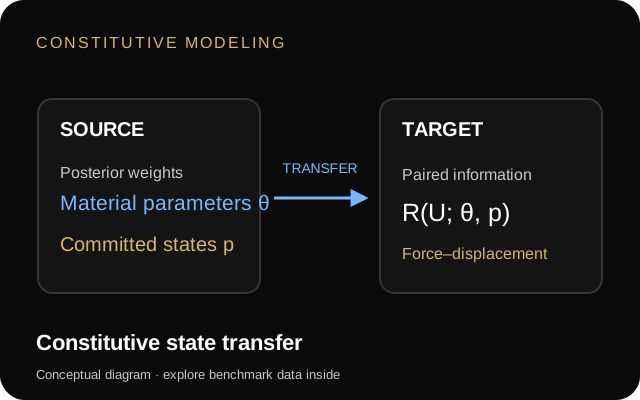
Benchmark boundary
Two compression-only elastoplastic elements are observation-equivalent in the source setting but retain different internal states. An asymmetric target exposes the loss caused by discarding or unpairing those states. Every compared method receives the same posterior weights and observation operator.
Units declared by the fixed protocol: displacement in mm, force in N and stiffness in N/mm. Seed: 20260910. The benchmark uses 512 synthetic virtual records per noise level; no experimental-accuracy claim is made.
Executed mechanical transfer
State-aware force–displacement replay
Inspect the archived three-element elastoplastic benchmark through its complete load–unload–reload path. The force curve, retained material states, cursor and probe inference use the same executed source arrays.
Source to target
Constitutive information transferred
Each realization keeps its parameters and its own committed plastic state. The target curve changes when those states are reset.
Realization I50.0%
Source state p = (0.667, 0.273) mm
Target state: Retained with its realization
R(U) = 0.000 N
Realization II50.0%
Source state p = (0.273, 0.667) mm
Target state: Retained with its realization
R(U) = 0.000 N
- Imposed target U
- 0.000 mm
- Weighted reaction R
- 0.000 N
- Port approach Q
- 0.000 mm
Constitutive benchmark data at the selected loading increment. This panel shows material-state transfer; the mass–spring vibration animation is in Machine Dynamics.
Loading · increment 1 / 601
- Target U
- 0.000 mm
- Imposed approach
- Mean reaction
- 0.000 N
- Paired-state law
- Frame compression
- 0.000 mm
- R / kf
- Port Q
- 0.000 mm
- U − R / kf
- Element 1 q₁
- 0.000 mm
- a₁Q
- Element 2 q₂
- 0.000 mm
- a₂Q
One shared physical observation
Probe at U = 0.45 mm
Gaussian likelihood with the selected σ. Every method receives these same posterior weights; changing the observation changes inference, not the archived constitutive curves.
Information retained
Realization probabilities and committed states
Committed p = (0.667, 0.273) mm
Committed p = (0.273, 0.667) mm
PACT continues each parameter realization with its own committed state. “Parameters · reset states” deliberately starts both target responses from virgin state and is an ablation, not a competing experimental model.
Model parameters, provenance and decisive checks
| Member | k [N/mm] | Y [N] | H [N/mm] |
|---|---|---|---|
| 1 | 12 | 1.2 | 0.6 |
| 2 | 4 | 2 | 0.4 |
Classification: Executed designed computational benchmark; not experiment or FEM output.
Source: public commit 7170abc5cc64; protocol a621d8846bf7.
Independent checks: oracle error 7.64e-14 N, equilibrium residual 1.70e-13 N, increment-halving error 8.35e-14 N.
No specimen geometry, paper/board/box experiment or FEM field is represented in this view.
Archived benchmark output
Matched-information method comparison
Compare methods that receive identical information. Initial transfer scores the complete target path; conditioned scores use one noisy probe and evaluate only subsequent increments.
Expected trajectory energy score [N]
Lower is better
These are archived outputs from a designed model-matched computational benchmark, not measurements or external experimental validation. Bayesian replay is an equivalence control; equality with PACT is expected by protocol.
27-configuration sweep
Robustness case explorer
Filter the complete public sweep: three stiffness ratios × three target gains × three preloads, with all five methods retained.
| Method | RMSE [N] | Energy score [N] | Coverage | Width [N] | Mean error [N] |
|---|---|---|---|---|---|
| Mean + replay | 0.440 | 0.440 | 27.3% | 0 | 0.345 |
| Parameters, reset state | 0.956 | 0.864 | 63.4% | 0.374 | 0.928 |
| Unpaired states | 0.336 | 0.207 | 100.0% | 0.991 | 0.192 |
| PACT | 0.275 | 0.138 | 100.0% | 0.402 | 0 |
| Bayesian replay | 0.275 | 0.138 | 100.0% | 0.402 | 0 |
Source permutation
0 N
Source observations coincide
PACT / replay gap
0 N
Equivalence control
Oracle error
7.64e-14 N
Numerical vs exact inversion
Equilibrium residual
1.70e-13 N
Maximum archived residual