Back to ProjectHub

Finite-element workflow · reduced mechanics

FEM Workflows for Corrugated Boards

Separate what is publicly executable from what still needs solver exports: inspect the open geometry/YACS workflow, then calculate an independent undeformed elastic cell using the paper’s published homogenization equations.

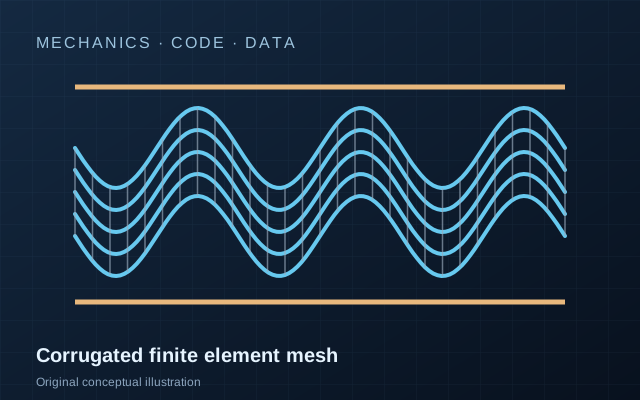
Conceptual finite element mesh following a corrugated profile.
Original conceptual illustration by Ricardo Fitas; not a solver mesh or scientific result.

Calculated reduced cell · not FEM

Elastic homogenization explorer

Evaluate the initial, undeformed sinusoidal flute with the compliance rotation and A/D integration published in equations 1–11. Every geometry and material change recomputes the cell in the browser.

Input provenance. E₁=3509.2 MPa, E₂=1330.4 MPa and E₃=0.0509 MPa are the paper’s Table 2 FCT estimates. Geometry, shear moduli (G₁₂=600 MPa; G₁₃=G₂₃=5 MPa) and Poisson ratios (0.3) are explicit demonstration assumptions because the paper does not provide a reusable calibrated input package. They are not claimed as experimental values.

Effective thickness

4.2655 mm

equation 10

Effective modulus

4.0165 MPa

equation 11 · reduced cell

Flute take-up factor

1.3902

arc length / pitch

Maximum local angle

54.73°

|atan(dH/dx)|

one period p = 8.00 mmliners: visual boundary onlyflute mid-line H(x)local material direction
Geometry is recalculated from H(x)=f/2·sin(2πx/p) and fitted with one uniform scale for x and y, so the white material directions follow the displayed tangent; narrow cells may not fill the frame. The gold liners provide context only: this unit integrates the sinusoidal flute and does not solve contact, buckling or compression.
Membrane stiffness A [MPa·mm]
row123
11.465e+11.679e+00.000e+0
21.679e+03.702e+20.000e+0
30.000e+00.000e+09.447e+0
Bending stiffness D [MPa·mm³]
row123
14.735e+15.419e+00.000e+0
25.419e+05.245e+20.000e+0
30.000e+00.000e+02.598e+1
Method, domain and decisive checks

The implementation builds the paper’s 6×6 compliance matrix, rotates it about the global y-axis, inverts the reduced 3×3 block, and integrates A and D over one period with 512 trapezoidal intervals. Units remain MPa and mm throughout.

Validator acceptance: a flat cell must recover the input paper thickness; 512 intervals must agree with 4096 intervals to within 0.05% for both effective quantities; matrices must remain symmetric; increasing flute height must increase the take-up factor.

Boundary: this is an independent calculator for the undeformed elastic cell. It is not a solver execution, FEM mesh, FCT replay, calibrated compression curve, contact model, Weibull softening model or reproduction of the paper’s validation specimens.

Compression mechanics · complete public-source audit

What the paper calculates — and what this page does not replay

The CC BY 4.0 paper links SCT, ECT and FCT experiments to inverse calibration, deformed-cell homogenization, Weibull softening and a final single-solid FEM proof of concept. The calculator above executes only its undeformed elastic equations 1–11; the remaining stages below are cited evidence, not browser-generated results.

Coverage state

1 executed subset · 3 source-only stages

No copied figures · no inferred curves

HOM · Elastic homogenization

Executed reduced calculation

Equations 1–11 transform an orthotropic compliance matrix over a sinusoidal flute and integrate A/D to estimate effective thickness and through-thickness modulus.

ProjectHub: The browser calculator executes this undeformed elastic subset with explicit geometry, material inputs and units.

Replay gap: Deformed overlapping functions Hᵢ(x,t), arc-length optimization inputs and the full compression sequence required by equations 12–14.

SCT/ECT · In-plane inverse calibration

Paper experiment plus numerical calibration

SCT strength and ECT response calibrate paper E_MD and E_CD using a buckling analysis and Tsai-Wu criterion.

ProjectHub: Eight published material/flute summaries are shown as cited evidence; no ECT solver is executed.

Replay gap: Raw SCT/ECT observations, specimen dimensions and conditioning, Tsai-Wu strengths, buckling model, optimizer settings and per-run predictions.

FCT · Out-of-plane inverse calibration

Paper experiment plus inverse homogenization

FCT response calibrates E_ZD and feeds the homogenized effective stiffness and thickness; the paper reports one analyzed sample.

ProjectHub: The four reported modulus values are cited below; the experimental load–deformation curve is not reconstructed.

Replay gap: Machine-readable load–deformation samples, geometry, force/displacement units and boundary conditions, optimizer objective/tolerance and correction-factor provenance.

W1/W2 + FEM · Statistical softening and proof-of-concept FEM

Paper calibration, validation tables and FEM illustration

Two Weibull distributions weight the homogenized global response for early contact degradation and stochastic flute buckling; a second specimen tests the fitted parameters before a single-solid linear-elastic FEM proof of concept.

ProjectHub: The two parameter sets and statistical comparisons are cited; no curve, field or solver replay is presented.

Replay gap: Both raw compression histories, the exact softening composition and normalization, specimen geometry, load/support steps, custom-material input, mesh, solver/version and nodal/element outputs.

Published SCT/ECT-derived paper moduli — mean ± SD, GPa
Material / fluteE_MDE_CD
Mixed B-flute1.68 ± 0.541.10 ± 0.37
Mixed C-flute1.69 ± 0.761.15 ± 0.57
Mixed E-flute1.46 ± 0.351.14 ± 0.23
Recycled B-flute1.59 ± 0.851.12 ± 0.36
Recycled C-flute1.47 ± 0.531.20 ± 0.60
Recycled E-flute1.77 ± 0.581.13 ± 0.62
Non-recycled B-flute1.75 ± 0.441.08 ± 0.21
Non-recycled C-flute1.89 ± 0.901.11 ± 0.51
Published FCT inversion — MPa
VariableValue
Experimental effective E5.588
Optimized E_MD,FCT3509.2
Optimized E_CD,FCT1330.4
Optimized E_Z,FCT0.0509
Published Weibull parameter sets
SpecimenContact β / ηBuckling β / η
Calibration E10.14 / 4.82e-71.31 / 0.96
Independent E20.11 / 4.22e-91.22 / 0.95
Paper comparison of E1 and E2
TestContact pBuckling p
Likelihood-ratio1.001.00
Kolmogorov–Smirnov<0.050.76
Bootstrap0.740.53

Validity boundary

  • The v1 manuscript states that it is under TAPPI review and has not yet been fully peer reviewed or accepted for publication.
  • The paper validates axial compression only and does not establish multiaxial or dynamic generality.
  • The proof-of-concept uses a linear-elastic single-solid representation; Weibull weighting approximates contact/buckling effects rather than mechanistic damage or plasticity.
  • Out-of-plane shear is not independently evaluated, and regular flute geometry omits manufacturing imperfections.
  • The paper notes restricted access to testing-machine troubleshooting data, limiting independent verification of possible machine malfunctions.

Public implementation boundary: The public repository supplies geometry generation and YACS workflow definitions. It does not supply a portable mesh, solver result archive, the paper's experimental tables as machine-readable data, a compression history or the final proof-of-concept FEM field export.

Decision: Keep the live undeformed homogenization calculator as a separate reduced model. Add a replay only after the complete experimental histories, deformed geometry contract and solver/export provenance are public and reusable.

Ricardo Fitas, Heinz Joachim Schaffrath and Samuel Schabel. arXiv:2507.02189v1, submitted 2 July 2025. CC BY 4.0. Repository commit 6264c13dd01c. Verified 2026-10-05.

Flat-crush FEM · paper and public-code audit

Three published geometries, one explicit replay boundary

The CC BY 4.0 study documents a two-dimensional Salome-Meca/Code_Aster workflow for three corrugated cells. The public MIT repository contains real geometry, mesh, contact and nonlinear-solver orchestration; it does not archive the generated fields needed to replay the paper in this browser.

Evidence state

3 cases · 5 reported displacement states

Source-audited · not browser-executed FEM

  1. STEP 1

    Geometry and mesh

    Python/NURBS construction of fluting, liners and rigid compression blocks, followed by Salome mesh generation and MED export.

  2. STEP 2

    Materials

    Orthotropic paper layers and an isotropic aluminium compression block use the published elastic constants listed below.

  3. STEP 3

    Contact and loading

    Penalty contact, fixed lower block and imposed vertical displacement of the upper block are assembled for a nonlinear Code_Aster solve.

  4. STEP 4

    Fields and post-processing

    The workflow requests displacement and stress/contact-pressure fields and contains MED/result export plus ParaView post-processing steps.

Published flat-crush cases and pictured imposed-displacement states
CaseWavelengthAmplitudePaper thicknessReported displacement states
A / Geometry 110 mm3 mm0.2 mm0.625, 1.25, 2.5 mm
C / Geometry 28 mm2.5 mm0.1 mm1.25 mm
E / Geometry 34 mm1.5 mm0.1 mm0.6 mm
Published orthotropic paper constants
SymbolValueUnit
E111.7090e+9Pa
E229.1800e+8Pa
E338.9947e+6Pa
G124.8473e+8Pa
G135.0000e+8Pa
G232.6229e+7Pa
nu120.3998—
nu130.001—
nu230.001—

Reported outputs — source evidence

  • Deformation and stress states for Geometry 1 at 0.625, 1.25 and 2.5 mm imposed displacement.
  • A deformation/stress state for Geometry 2 at 1.25 mm and Geometry 3 at 0.6 mm.
  • Top- and bottom-liner pressure distributions for all three geometries.

Aluminium block: E = 1.250e+11 Pa; ν = 0.25. No paper figure or field was copied.

Public workflow files at the verified commit

  • general_geometry.pySalome 2022 script for the two-dimensional NURBS geometry.blob 393d1eb101ca
  • YACS Schemes/Board simulation 2.xmlYACS study loop, geometry/mesh preparation and simulation orchestration.blob 4ebc4e6c1903
  • YACS Schemes/Corrugated_Board_FEA_Simulation.xmlCode_Aster contact workflow with displacement loading, nonlinear solve and MED/result export commands.blob 52512890d9d7

Available: Public geometry and YACS source, solver commands, material constants, three geometric cases and paper-reported output states.

Missing for replay: Committed generated MED mesh, result MED files, machine-readable displacement/pressure fields, load-deflection histories, exact solver build/runtime and regression reference outputs.

Decision: Do not interpolate paper figures or call the browser homogenization model a flat-crush FEM replay. Add an interactive replay only after exact reusable exports and solver provenance are public.

Symmetry 2025, 17(2), 257; peer-reviewed version of Preprints 2024, 202412.2302.v1. CC BY 4.0. Repository commit 6264c13dd01c. Verified 2026-10-05.

Evidence boundary

The CC BY 4.0 paper publishes the initial sinusoidal geometry, compliance transformation, A/D integration and effective-property equations. This page implements only that auditable elastic subset. The public MIT repository remains the source for geometry generation and YACS orchestration.

  • No public portable mesh, nodal/element field, load/support history or solver-version export is available for a verified FEM replay.
  • The optimization frames elsewhere in ProjectHub remain optimization iterations, not physical compression states.
  • Compression, contact, buckling and Weibull calibration remain source evidence until their complete reusable inputs are available.